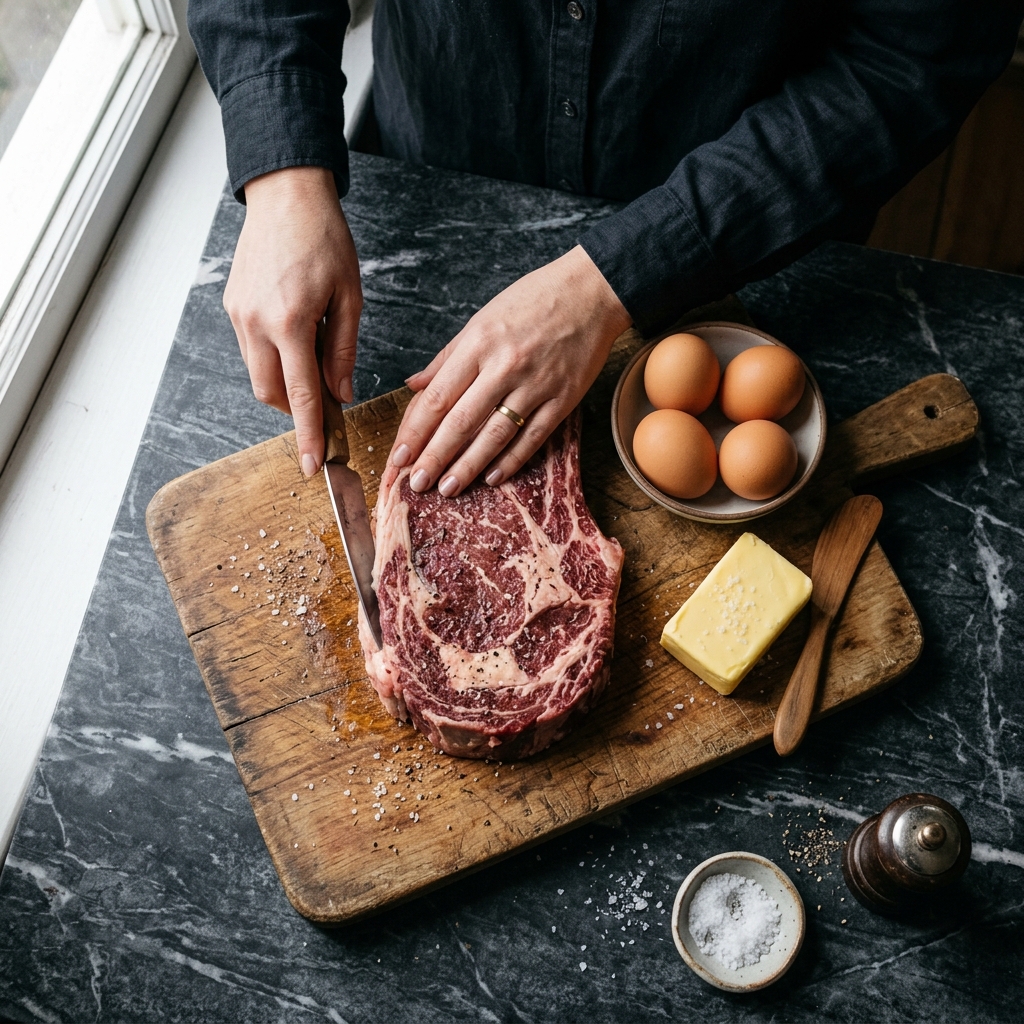
Carnivore Diet for Women: Hormones, Cycle, and Real Results
Most nutrition research has been conducted almost exclusively on men — which means the advice you read about the carnivore diet for women is often a direct copy-paste from male-focused studies, with a disclaimer bolted on at the end. Women are not smaller men. Your hormonal architecture, your menstrual cycle, your thyroid sensitivity, and your relationship with dietary fat all operate by completely different rules. This article is written specifically for you.

Why Women Respond Differently to Carnivore Than Men
When a man switches to a zero-carb, animal-based diet, his body tends to respond with rapid, linear results: weight drops, muscle stays, energy stabilizes. Women frequently report a more complex, non-linear experience — and there are solid physiological reasons for this.
First, women carry a higher percentage of essential body fat (approximately 10–13% versus 2–5% for men), and the body protects this fat aggressively because it is biologically tied to reproductive function. When caloric intake drops sharply or carbohydrates are eliminated suddenly, the female hypothalamus can interpret this as a signal of famine, temporarily suppressing hormones like LH (luteinizing hormone) and FSH (follicle-stimulating hormone). A 2018 study published in Frontiers in Nutrition found that very low-carbohydrate diets can alter hypothalamic-pituitary function in pre-menopausal women who restrict calories concurrently — a crucial distinction, because on a properly implemented carnivore diet (where fat intake is high and calories are not restricted), this effect is significantly reduced.
Second, women are more sensitive to cortisol fluctuations triggered by dietary change. The acute stress of metabolic adaptation hits harder and can take longer to resolve. This is not a weakness — it is a feature of a finely tuned hormonal system. Understanding it is the difference between quitting on Day 10 and thriving by Day 60.
The animal-based diet approach works for women — but the implementation requires nuance that generic carnivore guides skip entirely.
How Carnivore Affects Your Menstrual Cycle
The First Month — What to Expect
The most common report from women in their first 30 days on carnivore is cycle irregularity. Your period may arrive early, late, be lighter than usual, or in some cases temporarily disappear. This is not a sign the diet is harming you. It is your body recalibrating under a significant metabolic shift.
During the adaptation phase, insulin drops sharply. Since insulin interacts with sex hormone-binding globulin (SHBG), lower insulin levels cause SHBG to rise, which temporarily alters how your body binds and uses estrogen and testosterone. This recalibration can temporarily disrupt cycle timing.
The practical advice: do not panic. Track your cycle during this period, eat enough fat (this is non-negotiable — fat is the raw material for sex hormones), and give your body at least 60 days before drawing conclusions. Women who abandon the diet in week three because their period was five days late are making a decision based on adaptation, not the diet itself.
Why Some Women See Cycle Changes (And Why That's Normal)
Beyond the initial adaptation, women with conditions like polycystic ovarian syndrome (PCOS), endometriosis, or estrogen dominance often report significant improvements in cycle regularity after 60 to 90 days on carnivore. This is consistent with research: a 2020 pilot study in the Journal of the Academy of Nutrition and Dietetics noted that women with PCOS following very low-carbohydrate protocols experienced reductions in testosterone and improvements in menstrual regularity over 24 weeks.
The mechanism is insulin. PCOS is fundamentally an insulin-resistance condition. By eliminating carbohydrates entirely, you address the root driver of the hormonal imbalance rather than managing symptoms with medication alone.
Carnivore Diet and Female Hormones: The Science
Estrogen and Dietary Fat
Estrogen is synthesized from cholesterol. Cholesterol comes from dietary fat and internal production. When women adopt extremely low-fat diets, estrogen production can suffer — a well-documented phenomenon in female athletes with relative energy deficiency in sport (RED-S). The carnivore diet, rich in saturated and monounsaturated fats from beef, eggs, and butter, provides an abundance of the cholesterol precursors your endocrine system needs.
This is why women on carnivore who eat enough fat — particularly fatty cuts of beef, ribeye, and lamb — frequently report improvements in skin quality, libido, and mood. These are downstream effects of better-supported estrogen and progesterone production. The key word is enough. A carnivore diet built primarily on chicken breast and lean cuts will not provide this benefit.
Cortisol and Carbohydrate Restriction
Here is the nuance most carnivore advocates skip: eliminating carbohydrates does increase cortisol short-term. For men, this spike is brief and inconsequential. For women — particularly those already under chronic stress, sleeping poorly, or in perimenopause — an elevated cortisol baseline can amplify adaptation symptoms including insomnia, hair thinning, and cycle disruption.
The solution is not to abandon carnivore. It is to manage the adaptation intelligently. Prioritize sleep above all else during the first 30 days. Keep total stress low. Do not add intense cardio or caloric restriction on top of the dietary change. Eat more fat. Salt everything. Many women who report that carnivore "didn't work for them" were simultaneously under-eating, over-exercising, and sleep-deprived — a hormonal triple threat.
Common Mistakes Women Make on Carnivore
- Eating too lean: Chicken breast and turkey are not the foundation of a successful carnivore diet. Without adequate fat, your body cannot produce sufficient sex hormones, and you will feel depleted. Build your diet around fatty ruminant meat: ribeye, ground beef (80/20), lamb shoulder, pork belly.
- Cutting calories at the same time: Do not combine a carnivore transition with a caloric deficit in the first 30 days. Your body is already under metabolic stress. Eat to satiety. The fat loss will come naturally once you are adapted.
- Ignoring electrolytes: As insulin drops, kidneys excrete sodium. Women who do not replace sodium, potassium, and magnesium experience the keto flu at full force: headaches, heart palpitations, muscle cramps, and fatigue. Salt your food aggressively. Consider bone broth daily.
- Comparing their timeline to men's: If your male partner is losing 2 pounds per week on carnivore and you are losing half a pound, this does not mean it is not working. Female fat loss on carnivore is steadier and more sustainable. The hormonal protection of essential fat stores is your biology, not a failure.
- Quitting during adaptation: The first two weeks are the hardest for everyone, but especially for women. The physiological changes take longer to resolve. Commit to 60 days before making a judgment.
What Women Actually Eat on Carnivore (Sample Day)
A typical day on a well-constructed animal based diet for women looks straightforward. The goal is simplicity and satiety, not variety for its own sake.
| Meal | Food | Approx. Macros |
|---|---|---|
| Breakfast | 3 eggs fried in 2 tbsp butter + 200g ground beef (80/20) | ~55g protein, ~60g fat |
| Lunch | 300g ribeye steak, cooked in tallow. Salted generously. | ~70g protein, ~55g fat |
| Dinner | Salmon fillet (200g) + 2 poached eggs + 1 tbsp butter | ~55g protein, ~40g fat |
| Snack (if hungry) | Beef jerky or 2 hard-boiled eggs | ~20g protein, ~10g fat |
Total: approximately 200g protein, 165g fat, 0g carbohydrates. This is not a low-calorie diet. It is a nutrient-dense, hormonally supportive framework.
Results: What Women Report After 30, 60, and 90 Days
Based on aggregated self-reported data from carnivore communities and clinical observations on low-carbohydrate diets in women, here is a realistic breakdown of what to expect as carnivore diet women results:
- 30 days: 5–10 lbs total loss (mostly water and glycogen). Bloating disappears. Skin often clears. Energy is inconsistent — some days excellent, some days poor. Cycle may be irregular. Cravings for sugar drop significantly after Day 14.
- 60 days: True fat adaptation begins. Energy becomes stable. Sleep improves. Inflammation markers reduce — women with joint pain, eczema, or IBS frequently report marked improvement. Cycle often stabilizes or improves compared to pre-carnivore baseline. Fat loss accelerates modestly: 1 to 1.5 lbs per week.
- 90 days: Full metabolic adaptation. Body composition visibly changes even if the scale moves slowly — lean mass is preserved while fat deposits reduce. Women with PCOS or estrogen dominance symptoms often see meaningful hormonal improvements confirmed by bloodwork. Mental clarity is consistently reported as dramatically improved. The diet no longer feels restrictive — it feels intuitive.
A 2021 survey of 2,029 individuals on carnivore-style diets, published in Current Developments in Nutrition, found that 93% reported improved overall health, with women specifically noting improvements in mental health, digestive symptoms, and hormonal regularity as the most impactful changes.
Is Carnivore Safe Long-Term for Women?
The honest answer is: we do not yet have multi-decade randomized controlled trials on the carnivore diet specifically in women. That research does not exist for most dietary patterns. What we do have is a growing body of evidence on very low-carbohydrate diets, the evolutionary argument that humans thrived on animal foods for hundreds of thousands of years before agricultural grains, and tens of thousands of individual reports from women who have maintained this lifestyle for 2 to 5 years without adverse outcomes.
The concerns most commonly raised — kidney damage, bone density loss, cardiovascular risk — are largely based on extrapolation from other conditions (pre-existing kidney disease, high-protein diets without adequate fat) and have not been borne out in the limited prospective studies that exist. That said, annual bloodwork is wise. Monitor your lipid panel, kidney markers, thyroid (TSH, free T3), and iron levels. If you are in perimenopause or post-menopause, work with a physician who is open to reviewing your results in the context of a low-carbohydrate diet, rather than one who defaults to standard dietary guidelines reflexively.
FAQ
1. Can women do carnivore diet while pregnant?
Pregnancy is not the time to experiment with a radical dietary change. If you are already well-adapted to carnivore before conception, many women continue successfully throughout pregnancy with their physician's guidance. Animal foods are nutritionally dense and rich in folate (from liver), B12, iron, and DHA (from fatty fish) — all critical for fetal development. However, starting carnivore for the first time during pregnancy introduces metabolic stress and is not recommended without close medical supervision. If you are pregnant and curious, speak with a physician or registered dietitian who is familiar with low-carbohydrate nutrition.
2. Will carnivore diet affect my fertility?
For women with hormonal imbalances — particularly PCOS, which affects approximately 1 in 10 women of reproductive age — the carnivore diet's effect on insulin resistance may improve fertility markers over time. For women without underlying hormonal issues, temporary cycle irregularity during the adaptation phase (weeks 1–4) should not be interpreted as a fertility problem. The key risk factor for carnivore-related fertility disruption is under-eating: insufficient caloric intake from fat causes the hypothalamus to down-regulate reproductive hormones as a protective mechanism. Eat enough fat, and this risk is substantially reduced.
3. How much protein should women eat on carnivore?
A general guideline for women on carnivore is 1 to 1.4 grams of protein per pound of lean body mass per day. For a 140-pound woman with 25% body fat, this translates to roughly 105 to 147 grams of protein daily. However, protein should not be tracked obsessively — eat fatty meat to satiety and your intake will regulate naturally. More important than the protein number is the fat ratio: your calories should come roughly 65–75% from fat and 25–35% from protein by caloric proportion, not by weight. Lean-only carnivore (all chicken breast, no fat) leads to protein poisoning over time and is not sustainable.
4. Can carnivore diet help with PCOS?
Evidence suggests yes, particularly for insulin-resistant PCOS (the most common type). PCOS is strongly linked to hyperinsulinemia — chronically elevated insulin drives the ovaries to overproduce testosterone, disrupting ovulation and causing the hallmark symptoms: irregular cycles, acne, excess body hair, and weight gain concentrated around the abdomen. Eliminating carbohydrates lowers insulin dramatically. A 2020 pilot study found significant reductions in free testosterone and improvements in menstrual regularity in women with PCOS following a very low-carbohydrate diet over 24 weeks. The carnivore diet is among the most effective tools for reducing insulin load, making it one of the most logical dietary interventions for insulin-resistant PCOS.